Sovereign zone hosting
Zone records, configuration and DNSSEC signing keys stay in the region you pin them to. Nothing is replicated outside it.
Most providers split these across products or tiers. Resolve delivers them together, with regional data residency underneath.
Zone records, configuration and DNSSEC signing keys stay in the region you pin them to. Nothing is replicated outside it.
Route queries by geography, source IP or custom rules at resolution time, with EDNS Client Subnet for sub-region accuracy.
HTTP, TCP, ICMP and custom-script checks drive priority-group failover. Unhealthy endpoints leave the rotation in seconds.
Load records through the dashboard or the API. Each zone is parsed, validated and stored in your selected region.
Choose where zones, configuration, signing keys and query logs live. They are not copied anywhere else.
Define geo and source-IP rules, health probes, failover priorities and weights for each endpoint.
Queries reach the serving nodes in your assigned region, follow your rules and receive an answer from a healthy endpoint.
Pick which of our 52 data centres in 32 countries serve your zones: UAE only, GCC only, EU only, or any combination you need.
Data centres by region
Zones are signed through reusable DNSSEC Profiles, with the KSK and ZSK lifecycle managed for you and records re-signed on state changes.
ECS sharpens steering inside large countries and regions instead of treating the whole region the same way.
HTTP, TCP, ICMP and custom-script probes per record, with the action on failure and last-checked time in view.
Priority groups with automatic tier promotion, and round-robin or latency-ordered selection within the active tier.
DNS Zone Operator and DNS Zone Reader roles govern who can change zones, with separation of duties enforced by the platform.
Per-zone query trends with NXDOMAIN and SERVFAIL counts, query volume by serving node, and CSV export.
Real screens from the DNS Armor™ admin portal, not mockups.
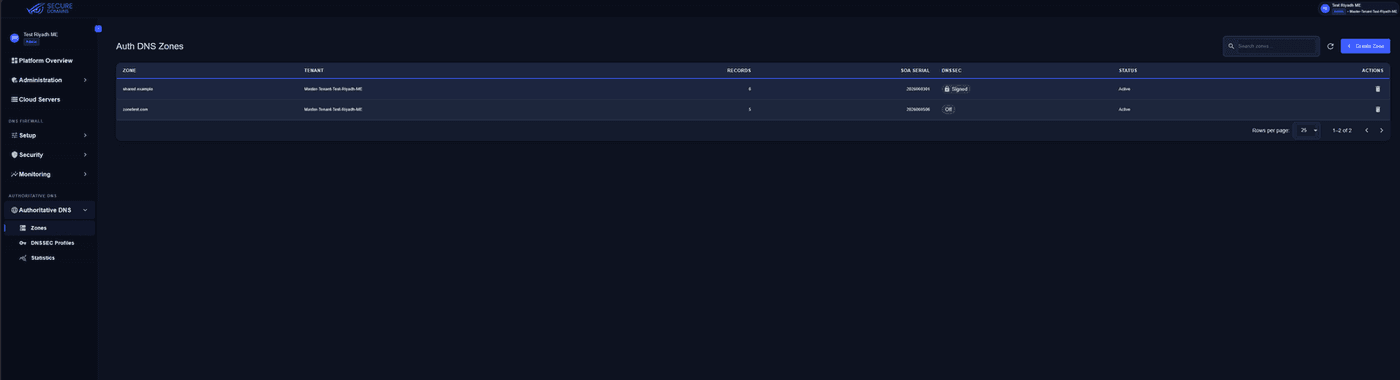
Every zone with its tenant, record count, SOA serial and DNSSEC status — signed or off — at a glance, with per-tenant isolation enforced by the DNS Zone roles.

Map source subnets to the addresses that answer them, with an explicit fallback when every endpoint is down: withdraw and serve the zone default rather than hand back a dead address.

Per-record checks with the action taken on failure, current state and last-checked timestamp, plus the primary and failover addresses in the rotation.
The documentation lists every supported record type and limit.
Resolve is licensed on its own, and self-service usage is billed automatically from live zone and record counts.
DNSSEC included. Enterprise licensing is available for larger estates.
per 10 zones, per month
per 100 DNS records, per month
Bring existing zones across without a flag day. Our team can walk you through the move on a call.
Export the records for each zone from your current provider or name server.
Load them through the dashboard or the API; every record is validated as it is imported.
Add DNSSEC profiles, steering rules, health checks and failover order before any traffic arrives.
Update the name servers at your registrar when you are ready. Statistics are live from the first query.
Yes. You pick which of the 52 locations serve your domains — UAE only, GCC only, EU only, or any mix you need. Your records, settings, DNSSEC signing keys and query logs all stay in the locations you choose and are not copied anywhere else. That is how the service is built, not simply what the contract promises.
In the same region as the domain they protect. DNSSEC is what proves an answer really came from you and was not tampered with on the way. Signing happens automatically using reusable profiles, and we manage the whole life of both signing keys for you, including replacing them on schedule. If a health check changes a record, it is re-signed straight away.
We continuously test each of your servers — by HTTP, TCP, ping, or a script you provide. You group servers by priority, and if every server in the active group fails, the next group takes over on its own. Within a group you can share traffic evenly or always send people to the fastest server. A failed server stops being given out within seconds.
Yes. It lets us direct visitors more precisely inside a large country or region, instead of treating the whole region the same way. One limit worth knowing: steering by CNAME is based on location only — those cannot be health-checked or ordered by speed.
Yes. Resolve and Protect are two separate licences and either works on its own — Resolve is not an add-on. With Resolve alone you get the authoritative DNS section and the shared platform tools, and the DNS Zone Operator and DNS Zone Reader roles decide who can manage your domains.
Import them through the dashboard or the API. Each domain is checked and validated as it loads, then stored in the region you chose. From there you set your routing rules, health checks and failover order, and switch over when you are ready. Statistics and live query reporting are available from the moment a domain starts serving.
Two roles cover DNS. A DNS Zone Operator can create and change domains, records, DNSSEC, routing and health checks; a DNS Zone Reader can see all of it but change none of it. These sit alongside one security role and one licensing role, so whoever manages DNS need not have any access to security policy — the system enforces that rather than relying on good intentions.
Yes — Dubai. The Middle East and Africa region also covers Doha, Riyadh, Cairo, Istanbul and Cape Town. In total the platform runs from 52 data centres in 32 countries, and you choose which of them serve your domains.
Book a 30-minute demo and see sovereign hosting, steering and GSLB on your own zones.